|

-
Dec 15th, 2021, 04:38 PM
#641
Member

Re: TwinBasic
 Originally Posted by Eduardo-

In previous posts I expressed that most of the potential newcomers won't probably come from other languages, but from people new to programming.
That's a very bold assertion. Why would somebody with zero programming experience choose a language that's currently pretty obscure, and likely to remain so for quite a while?
If I were to guess, I'd say that most early-adopters are from one or more of VBA, VB6 or COM. Maybe even some FreeBASIC or VB.Net too. I'd wager that newcomers in 2021 are probably not even very aware of BASIC, let alone tB.
-
Dec 15th, 2021, 04:55 PM
#642
Re: TwinBasic
Originally Posted by Eduardo-
And it is clear that what they wanted was exactly the opposite: to make programming something for an elite. And they got it.
Or maybe they just wanted to upgrade the language. What is it that Olaf likes to say? Occam's razor?
-
Dec 15th, 2021, 04:57 PM
#643
Re: TwinBasic
Originally Posted by mansellan
That's a very bold assertion. Why would somebody with zero programming experience choose a language that's currently pretty obscure, and likely to remain so for quite a while?
Because it is easier to learn.
What do you mean by "obscure"?
Unknown, difficult?
Originally Posted by mansellan
If I were to guess, I'd say that most early-adopters are from one or more of VBA, VB6 or COM.
VBA and VB6 don't have this awkward syntax.
Originally Posted by mansellan
Maybe even some FreeBASIC or VB.Net too. I'd wager that newcomers in 2021 are probably not even very aware of BASIC, let alone tB.
I'm thinking much more ahead. My expectation is that Basics will be ubiquitous in the future.
The main problem is that Browsers only interpret JavaScript, but I think that could not be a problem anymore if Web Assembly becomes a standard.
-
Dec 15th, 2021, 05:00 PM
#644
Re: TwinBasic
Originally Posted by Niya
Or maybe they just wanted to upgrade the language.
Seeing the results, I don't think so.
Originally Posted by Niya
What is it that Olaf likes to say? Occam's razor?
I know what Occam's razor is but not sure what you are saying.
-
Dec 15th, 2021, 05:01 PM
#645
Member
Re: TwinBasic
Actually, this is kind of an issue with C# - it evolves. Constantly. If I were to look at a non-trivial C# 1 application, it would look almost unreadable to me.
The downside is that C# now has a plethora of different syntax options. The (huge) upside is that each version makes it possible to write more concise, more expressive code. Boilerplate gets removed, and the signal-to-noise ratio gets ever better.
I just upgraded a non-trivial app from C#9 to C#10. This release was considered pretty passe in what it added, but it still allowed me to remove thousands of lines of code that became unnecessary (mostly "using" statements). That's a net win for me and anyone else who has to work with the code in future.
And no, I don't propose twinBASIC should go to that extreme. But some modern conveniences are in order.
-
Dec 15th, 2021, 05:04 PM
#646
Re: TwinBasic
Originally Posted by mansellan
That's a very bold assertion. Why would somebody with zero programming experience choose a language that's currently pretty obscure, and likely to remain so for quite a while?
This is a very good point. Just type in any programming concept while leaving out any mention of a language into Google. Nearly every single time Python will come up.
Try this:-
https://www.google.com/search?q=augm...hrome&ie=UTF-8
This is what shows up for me:-
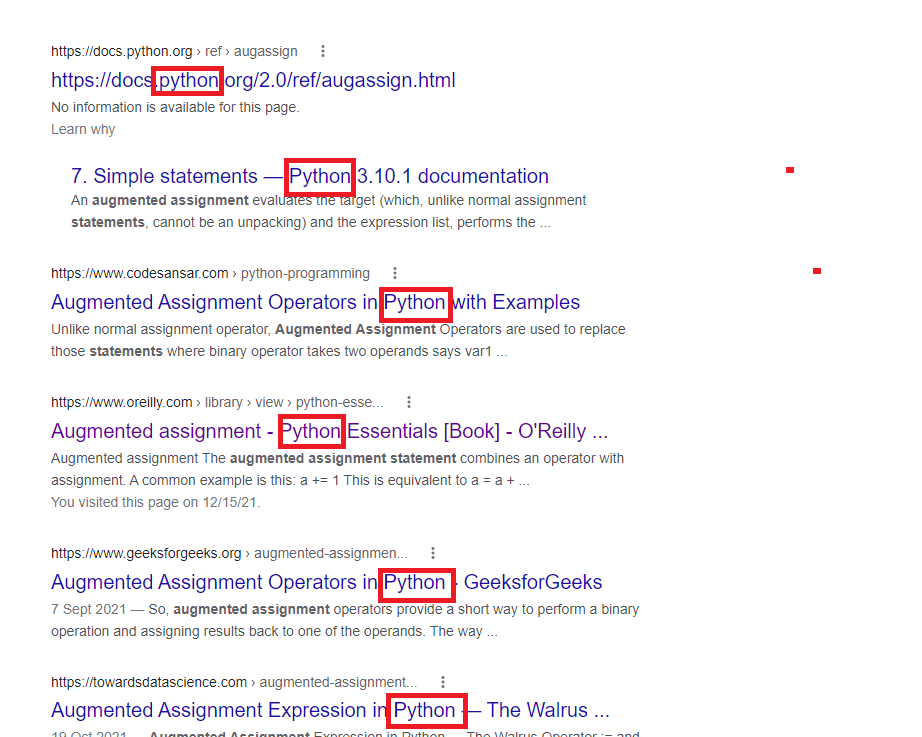
People looking to get into programming would likely run into Python first.
-
Dec 15th, 2021, 05:07 PM
#647
Member
Re: TwinBasic
Sorry Eduardo, I'm just not seeing it. When you come to a new language, either as a newcomer or from another language, there are some things to learn. The process for add-and-assign would be:
1. Huh, I haven't seen that before
2. Google
3. Oh Ok, it's just x = x + 1
Total time spent, maybe a minute? What's the problem?
-
Dec 15th, 2021, 05:10 PM
#648
Re: TwinBasic
Originally Posted by Eduardo-
I know what Occam's razor is but not sure what you are saying.
Occam's razor....the simplest answer is likely to be the right answer. We have two answers, only one of which could be correct.
1) They did it because of some massive internal conspiracy to turn BASIC into an elitist language.
2) They did it to improve the language.
Which of these two is the simpler answer.
-
Dec 15th, 2021, 05:13 PM
#649
Re: TwinBasic
Originally Posted by Niya
People looking to get into programming would likely run into Python first.
Yes, and Python didn't exist some years ago, or was obscure.
Of course being so short-sighted can't be changed the world.
Basic has the advantage that you already start with a... not large today, but still kind of big programmers base.
-
Dec 15th, 2021, 05:17 PM
#650
Member
Re: TwinBasic
Eduardo, if you want the modify-and-assign syntax that has been implemented in twinBASIC to be removed (replaced?), then you are most welcome to propose that on the GH repo. It would get labelled as a discussion, and the (nascent) community will consider it.
I don't think it would get much support though.
-
Dec 15th, 2021, 05:21 PM
#651
Re: TwinBasic
Originally Posted by Eduardo-
I'm thinking much more ahead. My expectation is that Basics will be ubiquitous in the future.
Again, Python is the most likely to succeed in this future. Do you know what random video showed up in my YouTube feed yesterday. Just out of nowhere....It was a video with a guy showing how to use Python in Excel in place of VBA. He also discussed a possible future where Python could replace VBA and he made a very convincing argument for this possible future by showing how much simpler it is to do certain tasks in Python over VBA.
My ultimate point is this. BASIC had it's time. Microsoft gave up on it to focus on C# and this allowed Python to fill it's niche. It's already lost the war. I'm sorry, but no matter how much we all like BASIC, it will not be ubiquitous in the future. I wish it were. There are some things about Python I really do not like but it seems I'm in a minority. The world wants it and there's nothing we can do about that.
-
Dec 15th, 2021, 05:29 PM
#652
Re: TwinBasic
Originally Posted by mansellan
Sorry Eduardo, I'm just not seeing it. When you come to a new language, either as a newcomer or from another language, there are some things to learn. The process for add-and-assign would be:
1. Huh, I haven't seen that before
2. Google
3. Oh Ok, it's just x = x + 1
Total time spent, maybe a minute? What's the problem?
You usually have to choose between options.
I once had to choose between Delphi and VB.
I liked VB more, I chose it.
What makes you like one over another? You probably don't know what are each individual thing that you like and you don't like, but being easy to read I'm quite sure is one of them.
Yes, when you get used to something, after a time, it becomes "good".
I'm quite sure, for example, that my aversion to curly braces would go away if I work for several months in a language with curly braces.
Could I work with a language with +=?, yeah, sure, I could also get used to a language with :=\|~.
Anyone could also google that syntax 8if used) and get it in a couple of minutes from google.
But myself I'm not aspiring to be a freak or nerd that understand (unnecessary) difficult things, I want the computer to help me do the things as easy as possible, and so a programming language. I want it to be friendly to me, easily readable.
I would had gone to Assembler otherwise, it was also available (and I already knew a bit of it).
And I don't think I'm alone.
Many, many people that raided into programming with VB in the 90 and 2000 has left when VB was abandoned and "replaced" with the unfriendly newborn. Or they are in Access, Office now.
-
Dec 15th, 2021, 05:33 PM
#653
Member
Re: TwinBasic
That's fair enough.
As someone who has to learn big paradigm shifts every 12 months with C# (and huge reams of "magic" being undertaken by the compiler - it literally rewrites your code when you use async), trust me when I say that += won't take long to get comfortable with. It'll look entirely normal after a couple of weeks.
EDIT: Oh, and I don't think anyone's had the temerity to suggest curly braces yet!
-
Dec 15th, 2021, 05:40 PM
#654
Re: TwinBasic
Originally Posted by Niya
Occam's razor....the simplest answer is likely to be the right answer. We have two answers, only one of which could be correct.
1) They did it because of some massive internal conspiracy to turn BASIC into an elitist language.
2) They did it to improve the language.
Which of these two is the simpler answer.
Occam's razor is not about the simpler answer but the simpler explanation.
And the simpler explanation, seeing the results and how they opposed to any and every request from the VB community, is that they were not interested in programmers.
-
Dec 15th, 2021, 05:46 PM
#655
Re: TwinBasic
Originally Posted by mansellan
Eduardo, if you want the modify-and-assign syntax that has been implemented in twinBASIC to be removed (replaced?), then you are most welcome to propose that on the GH repo. It would get labelled as a discussion, and the (nascent) community will consider it.
I don't think it would get much support though.
I don't think either. Because most seems to vote what Wayne already said he likes.
And there are how many there, 10?
And I guess that everybody are thinking on themselves (I'm not saying that's a wrong thing), not in a future mass adoption of Basic.
So, what for?
-
Dec 15th, 2021, 05:49 PM
#656
Re: TwinBasic
Originally Posted by Eduardo-
Yeap, but not easy for small companies or individuals.
It would be a pretty good master's project, though. Small, compact, and with interesting and useful results.
My usual boring signature: Nothing
 
-
Dec 15th, 2021, 05:50 PM
#657
Re: TwinBasic
one thing that I dont get. if basic is crap, as Niya is trying to say, why are you here at all?
twin"basic" is about basic, and Im sure the whole idea of twinbasic was to make VB6 a bit more robust for todays needs.
if u think Python is superior. why not just go and let us primitive people be here and believe in "basic".
now we know exactly why u are here, just to mess with us. that kind of people we dont need, go to your Python forum and stay there.
ironically u wrote that people in other forums have called u all kind of things, heavy stuff, and I wonder maybe you made them that angry with your attitude and it seems like you are seeking that here as well.
here we talk about Basic, and that we love Basic, and that we want to "Improve" Basic, not change it to something else, not to add other language and forget about Basic. because TwinBasic IS Basic. get it.
-
Dec 15th, 2021, 05:52 PM
#658
Member
Re: TwinBasic
Originally Posted by Eduardo-
I don't think either. Because most seems to vote what Wayne already said he likes.
That's really unfair. The debates I've seen have been pretty free ranging and ego free. If you have a killer point to make, it'll get traction. But at the end of the day "I like what I'm used to" is not going to get popular support. The heritage has to be respected, but that can't mean that nothing new can ever be implemented.
-
Dec 15th, 2021, 05:52 PM
#659
Re: TwinBasic
Originally Posted by Eduardo-
But your current point contradicts the other point that "VB lacks a short way to increment variables". May be you are not one of the proponents of a new syntax (I don't remember).
No, I was a proponent, I just thought the 'long names' argument was without much merit.
I agree with whoever felt that the ++ operator was opaque, but I've always liked +=, especially when you can concatenate with &=.
My usual boring signature: Nothing
-
Dec 15th, 2021, 05:53 PM
#660
Re: TwinBasic
Originally Posted by Niya
Again, Python is the most likely to succeed in this future. Do you know what random video showed up in my YouTube feed yesterday. Just out of nowhere....It was a video with a guy showing how to use Python in Excel in place of VBA. He also discussed a possible future where Python could replace VBA and he made a very convincing argument for this possible future by showing how much simpler it is to do certain tasks in Python over VBA.
My ultimate point is this. BASIC had it's time. Microsoft gave up on it to focus on C# and this allowed Python to fill it's niche. It's already lost the war. I'm sorry, but no matter how much we all like BASIC, it will not be ubiquitous in the future. I wish it were. There are some things about Python I really do not like but it seems I'm in a minority. The world wants it and there's nothing we can do about that.
Sorry, I try to see "beyond my eyes". I believe in things that still didn't happen.
I don't care what Google or Tiobe are saying now.
But I don't expect you to understand it.
-
Dec 15th, 2021, 05:56 PM
#661
Member
Re: TwinBasic
Just to reiterate:
FreeBASIC and VB.Net have both done this. Hell, classic VB would have if it had survived. There really isn't an argument that it's not BASIC-ish that I can see.
-
Dec 15th, 2021, 05:59 PM
#662
Re: TwinBasic
@Niya: I tried your search and came up with a wiki page on Augmented Assignment as the top item. After that it was all Python. I'd say that your search is flawed, though. I believe the term is primarily a Python term. I've certainly never encountered it before.
My usual boring signature: Nothing
-
Dec 15th, 2021, 06:00 PM
#663
Re: TwinBasic
Originally Posted by baka
if u think Python is superior. why not just go and let us primitive people be here and believe in "basic".
Actually I prefer BASIC over Python. There are some things about Python that I do not like. I absolutely hate dynamic typing along with the idea of using a variable without declaring it. I'm being forced to learn it right now and there really is no way out for me and the reason for this is because it's penetration is so deep now. It is everywhere.
However, preferences aside. Python isn't really that bad of a language and my personal tastes aside, I think it would be prudent to grab a couple ideas here and there for TwinBASIC. It really can't hurt.
-
Dec 15th, 2021, 06:01 PM
#664
Re: TwinBasic
Originally Posted by mansellan
That's really unfair. The debates I've seen have been pretty free ranging and ego free. If you have a killer point to make, it'll get traction. But at the end of the day "I like what I'm used to" is not going to get popular support. The heritage has to be respected, but that can't mean that nothing new can ever be implemented.
I already talked about the point in previous posts, I think the debates should be more abroad, and the alternatives analyzed better, what are the implications, what pros and cons have each one, not choosing in a rush or for wrong reasons.
There should be some professional way to take that kind of decisions, I mean, to design a programming language.
But I'm a bit tired. I was tired already many posts ago.
Do whatever you want (you'll do it anyway).
-
Dec 15th, 2021, 06:27 PM
#665
Re: TwinBasic
Originally Posted by baka
now we know exactly why u are here, just to mess with us. that kind of people we dont need, go to your Python forum and stay there.
You think I'm messing with you because I'm arguing for the inclusion of += family of operators?
You don't think it should have been included in TwinBASIC but I do. We have a difference of opinion. To classify a difference of opinion as me messing with you seems a bit conceited. I have zero interest in riling you up.
Originally Posted by baka
ironically u wrote that people in other forums have called u all kind of things, heavy stuff, and I wonder maybe you made them that angry with your attitude and it seems like you are seeking that here as well.
The truth is I'm not a yes man. Never have been and this rubs people the wrong way. They just expect me to blindly follow whatever everyone else is saying like I'm some kind of zombie. That is never going to happen. My opinions are just as valid as yours. If you can't deal with that, that is not my problem. You aren't going to bully me into submission either with "heavy stuff" as you say. SDA tried it, uncleber tried it, yet I'm still here. But you can certainly try if you want.
One final point about me "messing" with people. I don't mess with people by trying to present reasoned arguments about my points complete with code snippets and citations. If my goal was to mess with you, I'd flood your inbox with beastiality porn from 20 different accounts. And yes, I have done this to people.
I say the things I say because I actually believe them. It is not to tease people into a frenzy. I will not hold myself responsible if you choose to react poorly to it.
-
Dec 15th, 2021, 06:34 PM
#666
Member
Re: TwinBasic
I really would never have imagined that supporting a universally-known operator could be so controversial until I found VBF...
-
Dec 15th, 2021, 06:39 PM
#667
Re: TwinBasic
its how u present your arguments.
if you say:
basic is dead, sorry but nobody is using it, "any other language" is superior basic.
and the next
I like basic, "any other language" is actually not that good
and next
I would like to put this and that into basic
so its all over the place.
I propagate for a clean, stable and strong basic.
how? to always think "what makes VB6 good?" and "what makes VB6 bad?"
and try to keep the good and improve the bad.
the "bad", how to convert it to be "good", so if we want to add a feature, first we need to think:
- the good of VB6, if we include all of it, how would it look.
if we instead use: but python do it like this, or C is doing this way. that means we are just "coping" another language instead of creating one from the existing language we have.
if basic was so bad, why are we still using it?
and its not just that VB6 is bad, but that it was abandoned by many.
just see the pro in this forum that gave us: directx, wia, gdi+, cairo to name a few,
that means VB6 is able, but someone need to give us the tools.
if VB6 was bad it shouldn't be possible. but it is, 20 years after they abandoned it.
that tells us something.
I don't care about +=, but everything else that will be added "without " the thought, "how to make it basic-like" instead of just "copy". because if you just want to copy other languages, why not just go to that language.
-
Dec 15th, 2021, 06:41 PM
#668
Re: TwinBasic
Originally Posted by mansellan
I really would never have imagined that supporting a universally-known operator could be so controversial until I found VBF...
It has little to do with the operator. It's the fact that I'm the one supporting it. I'm just a convenient target because I personify what VB6 programmers hate most which is the abandonment of VB6 by Microsoft and the rest of the world. I'm used to it though. It's not the first time I've found myself becoming a villain although it was never my intention. It is what it is.
-
Dec 15th, 2021, 06:50 PM
#669
Re: TwinBasic
Originally Posted by baka
basic is dead, sorry but nobody is using it, "any other language" is superior basic.
and the next
I like basic, "any other language" is actually not that good
I get why you'd be confused. Let's see if I can clear it up. I like BASIC because it's my most used language. I've been writing BASIC code in on form or another since I was something like 10 years old. I'm comfortable with it. I'm familiar with it. This however does not mean I think there aren't better languages. Do you know how many times I've advised people in the VB.Net section to pick up C# instead? I love VB.Net but I think C# is better. I myself still use VB.Net, not because it's better but because I love it.
Let me put it this way:-
Code:
MeLovinBASIC <> BASICIsBetter
Now with regards to TwinBASIC, we are talking about attracting new talent. Our love for the language has no weight whatsoever in this. You want to attract modern programmers, then you must make it attractive. You can do this by looking at what the most popular languages are doing and assimilate ideas from there. You don't do it by trying to re-invent the wheel. You do it by following trends. As far as shorthand operators go, the trend is for modern languages to include them.
Does this clear things up for you about my stance?
-
Dec 15th, 2021, 07:01 PM
#670
Re: TwinBasic
Originally Posted by Niya
It has little to do with the operator. It's the fact that I'm the one supporting it. I'm just a convenient target because I personify what VB6 programmers hate most which is the abandonment of VB6 by Microsoft and the rest of the world. I'm used to it though. It's not the first time I've found myself becoming a villain although it was never my intention. It is what it is.
No, it's because you're sitting there stroking that hairless cat and twirling your moustache.
My usual boring signature: Nothing
-
Dec 15th, 2021, 07:03 PM
#671
Re: TwinBasic
Originally Posted by Shaggy Hiker
@Niya: I tried your search and came up with a wiki page on Augmented Assignment as the top item. After that it was all Python. I'd say that your search is flawed, though. I believe the term is primarily a Python term. I've certainly never encountered it before.
No it's not a Python term. The official name for operators like += is augmented assignment operator. It's language agnostic.
-
Dec 15th, 2021, 07:04 PM
#672
Re: TwinBasic
Originally Posted by Shaggy Hiker
No, it's because you're sitting there stroking that hairless cat and twirling your moustache.
Lmao....
-
Dec 15th, 2021, 07:05 PM
#673
Member
Re: TwinBasic
Originally Posted by baka
its how u present your arguments...
I'm new here. There's clearly some history to these interactions, so I'll just call it as I see it.
Classic VB was abandoned by Microsoft. That's the only language they did that to. C# was a new invention (some would say a rip-off-with-improvements-of-java), and C++ was allowed to stay mostly native, with diversions and extensions for those that really wanted to use it to target .Net.
VB was kind of thrown to the wolves. All development on COM-native VB stopped in the early 2000s. If you wanted to keep current with VB, you had to move to VB.Net. And that was a big problem, because it ripped the heart out of the language.
VB should have gone the same route as C++ - basically COM-native, but with the CLR there if you wanted to opt-in. In fact, it could have been the perfect middle ground. A bridge between the two, COM by default but easy access to the CLR for those who wanted it.
But remember, this all happened in the early 2000s. Just when Longhorn was emerging. Way before Vista, plans were put in place to make Windows a managed code environment. They tried and failed to remove the COM underpinnings of Windows. But the die was cast.
So I say again - my fondest hope is that twinBASIC is the go-to COM language. The path that Microsoft didn't take. I get that you all hate VB.Net, because CLR. But it does have some nice language improvements, regardless of what it ends up targeting.
-
Dec 15th, 2021, 07:16 PM
#674
Re: TwinBasic
Originally Posted by Shaggy Hiker
No, it's because you're sitting there stroking that hairless cat and twirling your moustache.
Also, it's interesting. You guys almost saw something new today. I was actually in the middle of writing an apology to the VB6 community. I brought up my contentions here with the VB6 community on Reddit and someone pointed something out to me that I never thought of before. I was going to make a post apologizing to the VB6 members with a promise to try my very best to avoid creating conflict by bringing up VB.Net in VB6 topics even in cases where it is 10000% warranted and justified. I was in the middle of writing that post until I saw baka post this:-
ironically u wrote that people in other forums have called u all kind of things, heavy stuff, and I wonder maybe you made them that angry with your attitude and it seems like you are seeking that here as well.
I took this to mean that he thinks I deserved to be called names and be degraded online simply because I hold views counter to popular opinion. I changed my mind after that. I'm not apologizing to anyone that thinks I deserved to be told that my mom should have swallowed me.
I'm not angry at baka or anything like that and I don't hate him but I also don't feel good about apologizing to people who think I deserve to be treated like sub-human trash simply because of a difference of opinion.
-
Dec 15th, 2021, 07:20 PM
#675
Re: TwinBasic
yeah, I get that part,
but the irregularity is what makes it hard to know where you stand. it seems like you enjoy the argument and so you send an arrow when you find a target, and thats fine if you we know where you stand.
the last post showed your stand, but soon you will change tone and we are there again.
I don't think that a language need to accommodate everyone and show "we also got the latest ice-cream taste".
the importance is to show "we can do this with TwinBasic".
when I bought my first PC, it was not because PC was superior Amiga, it was because they did have a 16bit sound card that I needed.
when I first started VB6 was not because I knew basic, I was more of a pascal guy at that time. it was because it was easy to work with the "new" windows OS, while pascal it felt too complicated in windows so I switched.
theres a lot of languages, so how can TwinBasic survive? it can't just because it shows lots of features.
the only way is a community, easy to get started, availability, sources etc, that will help the language grow
and when guys like Olaf and The trick and others start to release components that can be used to create stuff, it will spread around and eventually even companies will feel its a good idea to try it out.
that is why "fully" compatible is the good strategy here.
why? because TwinBasic will get many experiences programmers on-board for free, and that will help the language grow.
without vbforums and the "few others before they died" I wouldn't be here.
a community is important, without it, the language will die.
if you try to make TwinBasic something that I can not recognize, I will not get on-board. theres a lot of other languages out there already, like you say, Phyton. I know a bit already, as its used in the gaming community a lot. and its evolving all the time as theres a demand for it. if I create a game using Phyton I will get "accepted" by the masses, as they recognize the engine.
so, the question is, why should I take a chance on TwinBasic if Phyton is growing in the gaming community? I should just go there?
so, everything is not obvious. just give the language lots of features means nothing.
a inviting GUI, a stable IDE, lots of samples, easy to understand, a forum, experts that are online everyday to give support.
new players? not sure there will be that many before the VB6-programmers are on-board.
and for us to go on-board TwinBasic need to be at least as good as VB6 and familiar.
-
Dec 15th, 2021, 07:30 PM
#676
Re: TwinBasic
Originally Posted by baka
yeah, I get that part,
but the irregularity is what makes it hard to know where you stand. it seems like you enjoy the argument and so you send an arrow when you find a target, and thats fine if you we know where you stand.
the last post showed your stand, but soon you will change tone and we are there again.
I don't think that a language need to accommodate everyone and show "we also got the latest ice-cream taste".
the importance is to show "we can do this with TwinBasic".
when I bought my first PC, it was not because PC was superior Amiga, it was because they did have a 16bit sound card that I needed.
when I first started VB6 was not because I knew basic, I was more of a pascal guy at that time. it was because it was easy to work with the "new" windows OS, while pascal it felt too complicated in windows so I switched.
theres a lot of languages, so how can TwinBasic survive? it can't just because it shows lots of features.
the only way is a community, easy to get started, availability, sources etc, that will help the language grow
and when guys like Olaf and The trick and others start to release components that can be used to create stuff, it will spread around and eventually even companies will feel its a good idea to try it out.
that is why "fully" compatible is the good strategy here.
why? because TwinBasic will get many experiences programmers on-board for free, and that will help the language grow.
without vbforums and the "few others before they died" I wouldn't be here.
a community is important, without it, the language will die.
if you try to make TwinBasic something that I can not recognize, I will not get on-board. theres a lot of other languages out there already, like you say, Phyton. I know a bit already, as its used in the gaming community a lot. and its evolving all the time as theres a demand for it. if I create a game using Phyton I will get "accepted" by the masses, as they recognize the engine.
so, the question is, why should I take a chance on TwinBasic if Phyton is growing in the gaming community? I should just go there?
so, everything is not obvious. just give the language lots of features means nothing.
a inviting GUI, a stable IDE, lots of samples, easy to understand, a forum, experts that are online everyday to give support.
new players? not sure there will be that many before the VB6-programmers are on-board.
and for us to go on-board TwinBasic need to be at least as good as VB6 and familiar.
Here's the thing baka. I don't disagree with what you're saying here. 100% VB6 compatibility should be the core mission and I have no problem with that. All I'm saying is that it cannot hurt to look around to see what languages like Python are doing and ape some of their stuff. And I happen to think that operators like += should be included. I am not advocating for everything to be adopted, for example, it doesn't need ++, -- or any of that. But the truth is, there are a lot of good features that other language have that TwinBASIC could benefit from without sacrificing the core mission of 100% VB6 compatibility. And this will also aid in attracting new talent from other programming languages who would expect some of these things. That is all I'm saying.
-
Dec 15th, 2021, 07:34 PM
#677
Member
Re: TwinBasic
@baka
That's my hope too. VB6, but better.
1. 64-bit compilation
2. Faster execution
3. Cross platform
4. Language improvements
It seems that the only one of these that's causing concern is #4. Bear in mind that the developer is extremely keen to get feedback on the GH repo, and that nothing is set in stone for the language canon until it reaches v1, which seems some way off (the GUI is still in the distance). I've heard talk of RFCs and governance, but bear in mind that this is a very small community right now - it can't really accommodate heavy governance. If you want to help guide the direction, I urge you to get involved in the GH discussions. Maybe later there can be an independent governance committee and standards approval, but for now this is a startup.
-
Dec 15th, 2021, 07:45 PM
#678
Re: TwinBasic
exactly, whats the point on creating twinbasic if theres no new feature.
we need all those low-level operations, but carefully thought to be as close possible the basic-language syntax.
and Im sure Wayne is doing his best to do that.
and I agree that "what are other languages doing that are great that could be useful in twinbasic",
but again, converted into basic-syntax, and carefully thought.
I see it like this:
keep VB6 spirit, everything new need to be evaluated, and if adapted, it need to be converted into basic-syntax.
what I don't like:
I like this C feature, add it now!
its like a english language.
if we start using Italian, Russian, German mixed together, it will be hard to understand:
Trapoco need gehe zu спать.
-
Dec 15th, 2021, 07:53 PM
#679
Re: TwinBasic
I just want to say one more thing about the "+=" debate, especially in regard to newcomers. This operator is not much different than saying 1 + 1 or 1 + 2. What is "+"? Shouldn't a true Basic force us to write X = 1 Plus 1? Perhaps we should make it even more natural English and enforce a syntax like "X Equals One Plus One". Of course not, because we learned as children what symbols like +, =, 1, 2, 3, etc.. mean. I have X school age children who might eventually be part of a new generation of programmers coming to a new generation of Basic. They are taught some programming at school and they have no problem understanding the += operator. AFAIAC it's done, the programming world has decided that it's a useful operator and whether you like it or not, you're wrong if you're on the other side of this one. It's like getting mad about the letter W. You've already lost, so pick a fight you can still win.
-
Dec 15th, 2021, 07:54 PM
#680
Re: TwinBasic
Originally Posted by baka
I see it like this:
keep VB6 spirit, everything new need to be evaluated, and if adapted, it need to be converted into basic-syntax.
So I take it that like Eduardo, you'd prefer an intrinsic function like this:-
Instead of this:-
Is this what you mean?
EDIT:
Or you could make it a binary operator like this:-
This is more BASIC-like too.
Last edited by Niya; Dec 15th, 2021 at 07:59 PM.
 Posting Permissions
- You may not post new threads
- You may not post replies
- You may not post attachments
- You may not edit your posts
-
Forum Rules
|
Click Here to Expand Forum to Full Width
|



 Reply With Quote


