|

-
Apr 13th, 2015, 07:35 AM
#1
Thread Starter
Fanatic Member

radius of circumcircle from 3 points formula... can someone explain?
Why is it that this formula works?
Code:
r=a*b*c/sqrt((a+b-c)(b+c-a)(c+a-b)(a+b+c))
this formula finds the radius of the circumcircle of a triangle (or three points, combining it with pythagoras), using the lengths of the sides of the triangle.
I have tested the formula several times, and it seemed to be accurate everytime, but I still don't understand why that is.. could someone help me understand this? How does this result in the radius?
Last edited by Justa Lol; Apr 13th, 2015 at 07:43 AM.
-
Apr 13th, 2015, 08:07 AM
#2
Re: radius of circumcircle from 3 points formula... can someone explain?
-
Apr 14th, 2015, 02:05 AM
#3
Thread Starter
Fanatic Member
Re: radius of circumcircle from 3 points formula... can someone explain?
Yes, that is where I got it from. However, just knowing the formula isn't helping a lot... I still don't understand why. It doesn't make sense to me.
-
Apr 14th, 2015, 03:10 AM
#4
Re: radius of circumcircle from 3 points formula... can someone explain?
-
Apr 16th, 2015, 03:39 AM
#5
Re: radius of circumcircle from 3 points formula... can someone explain?
First, here's why the circumcenter exists. Take two sides of a triangle and consider their perpendicular bisectors. Since the sides are not parallel, neither are the perpendicular bisectors, so they intersect. From symmetry, the perpendicular bisector of any line segment is precisely the collection of points which are equidistant from both endpoints. The point of intersection is then equidistant from all three endpoints (both pairs, though one vertex must be used twice, giving 3 instead of 4 total). It follows that the perpendicular bisectors of the sides of the triangle all intersect at a single point, namely the circumcenter. I should pause here to note that it's really, really easy to find the circumcenter for any given particular triangle if you know its vertices by this method, and from there you can compute the circumradius using the distance formula---just compute the perpendicular bisectors and intersect them algebraically. This gives a brief algorithm rather than a single equation, though.
Next, what is the radius of the circumcircle? For simplicity, take the case when the triangle is acute, so the circumcenter is within the triangle. Draw lines from the circumcenter to the three vertexes as well as from the circumcenter to the medians, which cuts the triangle into six smaller, *right* triangles. The two triangles touching the side with length "a" have an angle alpha at the circumcenter vertex. Likewise the two triangles touching side "b" have an angle beta and those touching side "c" have an angle gamma. Since these angles make up a full revolution, alpha + beta + gamma = pi. Also, since these are right triangles, we have
(a/2)/sin(alpha) = r
(b/2)/sin(beta) = r
(c/2)/sin(gamma) = r
alpha+beta+gamma = pi
If you use some basic identities, you get
sin(gamma) = sin(alpha + beta)
= sin(alpha)cos(beta) + cos(alpha)sin(beta)
so
(c/2) = r sin(gamma)
= r sin(alpha) cos(beta) + r cos(alpha) sin(beta)
= (a/2) cos(beta) + (b/2) cos(alpha)
If we square the LHS and RHS of this equation, we can apply the Pythagorean Theorem to exchange the cosines for sines, which can then be replaced by a's, b's and r's. We unfortunately get a cross term, cos(beta) cos(alpha). If after squaring we put the term with cos(beta) cos(alpha) on a side by itself and square again, we can get rid of all the trig functions and we end up with a (horrific) expression involving only a's, b's, c's, and r's. In fact, while you would expect it to have r^2's and (r^2)^2's, the r^4'ths cancel, and if you're magical (or use a computer algebra system...) you can factor the rest of the terms down to...
(a - b - c) (a + b - c) (a - b + c) (a + b + c) + (a^2 b^2 c^2)/r^2 = 0
This is easily equivalent to your expression. There must be a nicer proof (and one that doesn't add the apparently artificial condition that the triangle be acute)--please post it if you find it.
The time you enjoy wasting is not wasted time.
Bertrand Russell
<- Remember to rate posts you find helpful.
-
Apr 17th, 2015, 08:45 PM
#6
Re: radius of circumcircle from 3 points formula... can someone explain?
It could also be explained in terms of the area of the triangle and Heron's formula.
We can write the area of triangle ABC as 1/2 * base * height = 1/2 * b * c * Sin(A).
We can calculate sin(A) in terms of the circumcircle radius R like this:
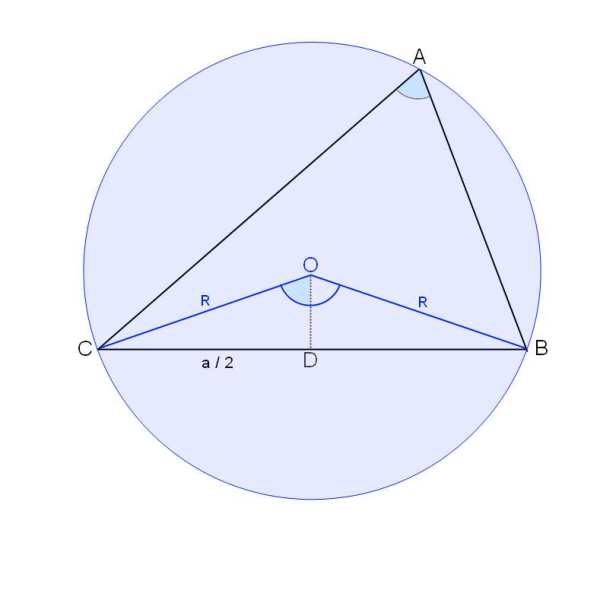
The angle subtended by chord at the centre a circle is twice that subtended at the circumference.
Chord BC subtends angle A at the circumference, so the angle at circumcentre O is 2 * A.
COB is an isosceles triangle, so the perpendicular bisector OD cuts the angle into equal halves.
Angle COD is therefore equal to A.
So we can calculate the sine as:
Sine(A) = CD / OD = (a /2) / R
and we can write the area of triangle ABC as:
1/2 * b * c * (a / 2) / R
= 1/4 * a * b * c / R
Heron's formula for the area of a triangle, which has been kicking around for a good 2,000 years, is usually written as:
area = sqrt((s * (s-a) * (s-b) * (s-c)) (where s = 1/2 * (a + b + c))
But we can also write it without using s like this:
area = 1/4 * sqrt((a + b + c) * (b + c - a) * (c + a - b) * (a + b -c))
Now we have two expressions for the area of triangle ABC which must be equal. So
1/4 * a * b * c / R = 1/4 * sqrt((a + b + c) * (b + c - a) * (c + a - b) * (a + b -c))
And turning it around to get R:
R = a * b * c / sqrt((a + b + c) * (b + c - a) * (c + a - b) * (a + b -c))
As far as I can see, it isn't limited to acute triangles.
BB
Last edited by boops boops; Apr 17th, 2015 at 08:57 PM.
-
Apr 17th, 2015, 11:57 PM
#7
Re: radius of circumcircle from 3 points formula... can someone explain?
@boops boops: for what it's worth, I made an effort to avoid Heron's formula since it seemed like its use just pushes the problem farther down the line--why is Heron's formula true? On the other hand there are many easy-to-find proofs of Heron's formula, whereas this circumradius formula seems harder to come across. Yours also uses the inscribed angle theorem which, while nicely intuitive, is a bit less well-known than the basic identities I was able to stick to. Of course, your proof is able to sidestep the ugly algebra which I didn't even bother to write down, which is a big plus. I should probably have mentioned that the denominator is basically from Heron's formula.
Your proof, like mine, is just in the acute case. That's not to say our arguments can't be modified to work more generally. If you imagine pulling C and B in your drawing up past the circumcenter so the line between them remains horizontal and the vertical distance between that line and the circumcenter is unchanged, the angle COB is the same but the angle A is larger, so they're no longer quite so nicely related. You would need to use the "external angle" case of the inscribed angle theorem there, but it presumably all works out--I won't take the time to think it through myself.
The time you enjoy wasting is not wasted time.
Bertrand Russell
<- Remember to rate posts you find helpful.
-
Apr 18th, 2015, 08:02 AM
#8
Re: radius of circumcircle from 3 points formula... can someone explain?
 Originally Posted by jemidiah

@boops boops: for what it's worth, I made an effort to avoid Heron's formula since it seemed like its use just pushes the problem farther down the line--why is Heron's formula true? On the other hand there are many easy-to-find proofs of Heron's formula, whereas this circumradius formula seems harder to come across. Yours also uses the inscribed angle theorem which, while nicely intuitive, is a bit less well-known than the basic identities I was able to stick to. Of course, your proof is able to sidestep the ugly algebra which I didn't even bother to write down, which is a big plus. I should probably have mentioned that the denominator is basically from Heron's formula.
It was the vague familiarity of the denominator that started me off. I wondered too about the fairness of assuming Heron's formula. We do have to take some things as proven don't we? By contrast, we don't usually hesitate about relying on Archimedes' Theorem because we use it all the time in our right-angled world so it's totally familiar. The proof of Heron isn't much more difficult and they are both hallowed by Antiquity. But it would be nice if there were a convincing graphic proof of Heron like that for Archimedes. The nearest I've seen is this, but I don't think it lives up to its claim of being a "proof without words".
As for the central angle of a chord being double the circumferential angle, it's easy enough to prove without resorting to Euclid.
Starting with the circumcircle diagram, let the base angles of isosceles triangle COB = q:
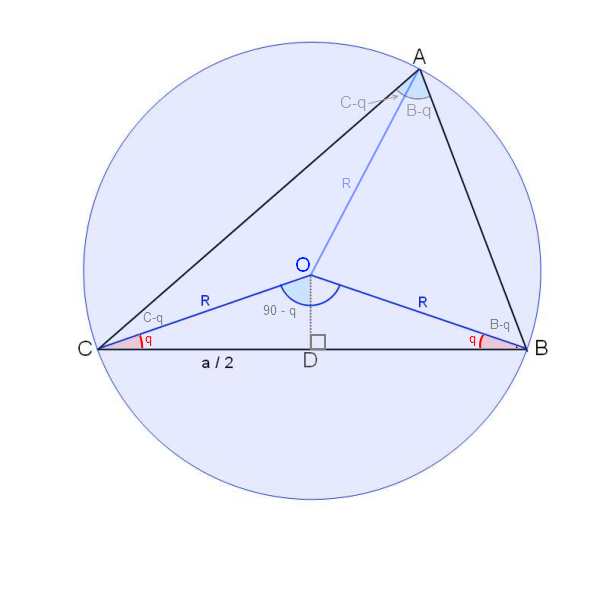
Then the base angles of isosceles triangle AOC = C - q and those of isosceles triangle AOB = B - q
Therefore A = B + C - 2 * q.
So q = 1/2 * (B + C - A) = 1/2 * (A + B + C - 2 * A) = 90 - A.
Therefore the top angle of right triangle COD = 90 - q = A.
BB
Last edited by boops boops; Apr 21st, 2015 at 02:16 PM.
Reason: image was corrupted
-
Apr 19th, 2015, 10:52 PM
#9
Re: radius of circumcircle from 3 points formula... can someone explain?
That article is nice and brief, and it gives some notion of what the parts of Heron's formula individually "mean". It does something quite similar to what my proof does, but with the incircle rather than the circumcircle. It sidesteps my ugly algebra with a clever geometric lemma. It could probably be tweaked to give the circumradius formula directly, but again I won't take the time.
The time you enjoy wasting is not wasted time.
Bertrand Russell
<- Remember to rate posts you find helpful.
 Posting Permissions
- You may not post new threads
- You may not post replies
- You may not post attachments
- You may not edit your posts
-
Forum Rules
|
Click Here to Expand Forum to Full Width
|



 Reply With Quote


