|

-
Apr 23rd, 2013, 06:04 PM
#81
Re: Note to community
The commutes too long for that.
I'm going to resort to using snide commenting in my code, instead.
My usual boring signature: Nothing
 
-
Apr 23rd, 2013, 06:23 PM
#82
Re: Note to community
lol....
-
Apr 23rd, 2013, 06:38 PM
#83
Thread Starter
Lively Member

Re: Note to community
Well on the bright side looks like I've created a good topic to discuss. I've learned a little here and I hope everyone else has picked up something as well. I really joy these discussions. So nice to debate and learn new stuff through debate. I will try to limit my commenting in the future.
-
Apr 24th, 2013, 12:05 AM
#84
Re: Note to community
 Originally Posted by Vladamir

I agree with the OP that comments are important but there is a time and a place for everything and sometimes just posting a quick snippet will suffice without comments. What I can complain about is a block of code which requires an Imports statement and those are left off. My increase in experience with VB has made this less of a problem than when I first started. But I can tell you that in the beginning this was a real problem for me. Code will run fine with or without comments. But without the correct Imports it will not run and the IDE doesn't always indicate which of the many thousands of available options are needed.
The MSDN documentation for every single type includes what assembly it's defined in and what namespace it's a member of so it's never more than a 10 second job to determine what Imports are required.
-
Apr 24th, 2013, 02:31 AM
#85
Re: Note to community
I will try to limit my commenting in the future.
It's not so much about limiting it, it's abut targetting it. I think JM hit the nail pretty much on the head for me when he said commenting is about explaining "why" rather than "what". The next developer, if he is even half way decent, can see the "what" at a glance. The "why" is much harder to spot.
I think the debate, really, is about how you should explain the why. Us minimalists believe our primary method of doing that should be the code itself. Maximalists (if there is such a thing) believe that explicit commenting is better and/or adds an extra level of clarity above and beyond what the code itself can. Ultimately, it doesn't really matter which of us is right because it's not about the comments or the code, it's about the clarity. As long as clarity is achieved than it doesn't really matter how.
I found that it did not capture the intent very well at all
I must admit that I found the .Any jarring as well and would probably have gone with .Count > 0. I guess that's only because it's a property that was new to me though. I thought the really good stuff EG demonstrated was breaking out the helper methods. Because that gives you a chance to explicitely name the helper method it also gives you a chance to encapsulate a great deal of information in that name. It's really the High-Cohesion principle applied at a method rather than class level and is, IMO, a much better way of writing your code.
Like I said, though, I personally still struggle with it. My ingrained tendancy is to have the problem mapped out in my head and just want to dump it down onto the screen. That tends to lead me to writing one big long method. Decomposing it into tiny parts is very much a concious, and not very comfortable, step for me. Still, I think it's one worth taking.
On the performance vs readability issue, I think you're being a little unfair when you say "one day you have to rewrite the whole thing" (I'm paraphrasing because I'm on the next page of the thread) because that's not what happens. What does sometime happen is that a particular part of the program becomes a bottleneck. So then you just refactor that particular part to optimise it and then, yes, you will sacrifice readability for speed.
Last edited by FunkyDexter; Apr 24th, 2013 at 02:45 AM.
The best argument against democracy is a five minute conversation with the average voter - Winston Churchill
Hadoop actually sounds more like the way they greet each other in Yorkshire - Inferrd
-
Apr 24th, 2013, 03:52 AM
#86
Re: Note to community
I think this discussion has pretty much run its course. We've basically got to the point where we're just restating our positions now, but a couple of final points worth addressing:
Originally Posted by Shaggy Hiker
However, would you write slow code rather than fast simply because it is easier to read? That would be an argument for implicit conversions and option Strict OFF. After all, if you can be certain that a certain string holds a number, then MyString = 5 is considerably more readable than CInt(MyString) = 5, or any other proper conversion. Anybody can read the first variation without problem, but somebody new to programming would likely be unsure what CInt(MyString) was doing in the second variation. Option strict does prevent certain bugs from slipping in, but probably not bugs that you would allow anyways.
No, I wouldn't code with implicit conversions, because it's not about "easier to read" it's about "easier to maintain". It's about the process of going from the code displayed on screen to a sufficiently accurate mental model of the intent of the code in the programmer's head. Implicit conversions may transfer the textual representation into your brain more easily, but then you need to figure out where all the converting occurs, which makes it harder to understand.
Originally Posted by Shaggy Hiker
Furthermore, if you are in the habit of reaching for the slower tool because it looks better to you, wouldn't you expect that performance is more likely to be an issue than it would for a person who is in the habit of reaching for the fastest tool? A fraction of a millisecond here and there usually makes no difference at all, until you end up working on a program where it does matter and you have to go back and re-work it because you neglected to do so on the first pass. In this case, I feel that .Any is less clear than .Count >0, but that's just a matter of opinion. Still, knowing that there is a difference of opinion there (and I'm clearly not alone in my view, since we aren't talking about code I initially wrote), wouldn't it be better to reach for the tool that works better?
If it comes down to a choice between fast or clear then I would definitely choose clear on the first pass. The reason is that it's very easier to sacrifice the clarity for speed if you need to, but it is much harder to understand that fast code later. Since it is much more likely that you need to modify code for bugs or changing requirements than you are to need to improve its performance, it is always worth striving for the clarity over speed.
Also, the question on performance isn't "which is faster", it should be "which is fast enough?". If you have two approaches, and only one meets your performance budget (whether that be speed (with all its sub categories [time-to-first-byte, time-to-last-byte, throughput]), memory, power consumption, etc), then you clearly need to use that approach. If neither meets your performance budget, well then you've got a problem. If both meet your performance budget then you choose the clearest code - even if it isn't the fastest. Note that all this assumes you have a performance requirement you need to meet. If you don't have a performance requirement (and, no, "must be fast" isn't a performance requirement) then you don't have a performance problem - and prematurely optimising before you have any performance data has the potential to make your performance worse. Also, optimising in one area could cause a bigger slowdown somewhere else.
So as another saying you may have heard goes: "Measure twice, cut once". Except that in performance considerations your two measures need to be one before and one afterwards.
-
Apr 24th, 2013, 04:00 AM
#87
Re: Note to community
Originally Posted by FunkyDexter
My ingrained tendancy is to have the problem mapped out in my head and just want to dump it down onto the screen. That tends to lead me to writing one big long method.
I can't remember who said earlier in the thread that they tend to write pseudo-code comments to define the top level idea of the method. I do something similar in that I don't think through the details when I first approach a method. I know that to do X, i will need to do A, B and C, but I don't particularly worry about how I'll do A, B or C straight off. However, instead of writing comments like this:
vbnet Code:
Public Sub doX()
    ' do A
    ' do B
    ' do C
End Sub
I'll instead write something like this:
vbnet Code:
Public Sub doX()
    doA()
    doB()
    doC()
End Sub
I can use the IDE to insert method stubs for those three methods. Now when I'm thinking about how to implement A, I write that code in the doA method, rather than under the doA comment in the doX method.
Well, that's actually highly simplified to the point where I don't actually recognise that as my approach, but it's kinda how I work.
-
Apr 24th, 2013, 10:35 AM
#88
Re: Note to community
Originally Posted by Evil_Giraffe
I think this discussion has pretty much run its course. We've basically got to the point where we're just restating our positions now, but a couple of final points worth addressing:
Heck, I thought it had run its course before it got moved to General Developer. I'm surprised at how much, and how well, it has taken off since then. Rather nice, really.
No, I wouldn't code with implicit conversions, because it's not about "easier to read" it's about "easier to maintain". It's about the process of going from the code displayed on screen to a sufficiently accurate mental model of the intent of the code in the programmer's head. Implicit conversions may transfer the textual representation into your brain more easily, but then you need to figure out where all the converting occurs, which makes it harder to understand.
If it comes down to a choice between fast or clear then I would definitely choose clear on the first pass. The reason is that it's very easier to sacrifice the clarity for speed if you need to, but it is much harder to understand that fast code later. Since it is much more likely that you need to modify code for bugs or changing requirements than you are to need to improve its performance, it is always worth striving for the clarity over speed.
Also, the question on performance isn't "which is faster", it should be "which is fast enough?". If you have two approaches, and only one meets your performance budget (whether that be speed (with all its sub categories [time-to-first-byte, time-to-last-byte, throughput]), memory, power consumption, etc), then you clearly need to use that approach. If neither meets your performance budget, well then you've got a problem. If both meet your performance budget then you choose the clearest code - even if it isn't the fastest. Note that all this assumes you have a performance requirement you need to meet. If you don't have a performance requirement (and, no, "must be fast" isn't a performance requirement) then you don't have a performance problem - and prematurely optimising before you have any performance data has the potential to make your performance worse. Also, optimising in one area could cause a bigger slowdown somewhere else.
That all sounds good to me. I recognize that part of my views comes from working on a series of projects that have real potential for running into slowdowns due to the likelihood of having LOTS of iterations, but often unknown numbers of iterations. That situation argues for watching the time taken in any one particular iteration. A type of program that I tend to work on a fair amount where this applies would be Genetic Algorithms, where each individual generation is trivial...but there are so MANY of them. Still, in a general business app, I think I would do it the way you suggest.
So as another saying you may have heard goes: "Measure twice, cut once". Except that in performance considerations your two measures need to be one before and one afterwards.
That's a fine statement for a tailor, but pointless for software development. The cost of the measurement in software development can easily be higher than the cost of cutting incorrectly.
My usual boring signature: Nothing
-
Apr 24th, 2013, 01:17 PM
#89
Re: Note to community
Originally Posted by Shaggy Hiker
The cost of the measurement in software development can easily be higher than the cost of cutting incorrectly.
This is true if you expect the analogy to hold. The measurements are of course completely different for the tailor and the software developer. It's more like expecting the tailor to measure how much cloth he has, and if he doesn't have enough then try cutting up a certain piece of cloth, and then measure all the cloth again. If he now has less cloththan before then he needs to stitch the piece he cut back together and try a different cut, if he now has more cloth but still not enough then he should keep that cut and try cutting a different piece and if he has now has enough cloth then he should stop cutting.
Ye-e-e-eah, I think that saying doesn't really apply in the performance optimisation scenario.
-
Apr 24th, 2013, 02:05 PM
#90
Re: Note to community
It should be: measure 1 - Requirements; measure 2 - design ... but rather often if falls into a cycle more like this:
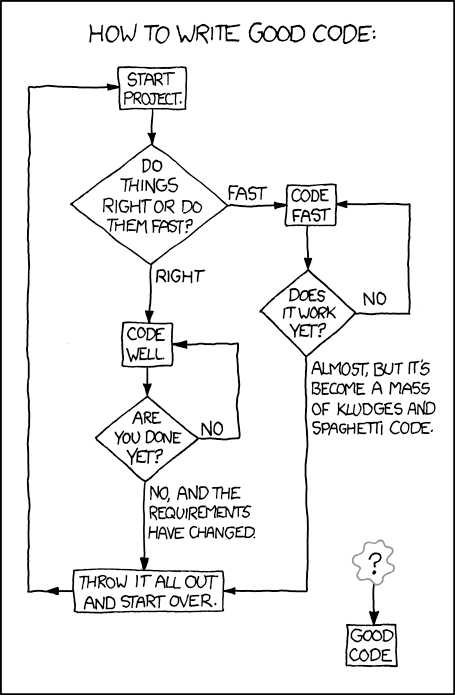
-tg
-
Apr 24th, 2013, 02:54 PM
#91
Re: Note to community
That's a painfully accurate diagram. xkcd is pretty awesome.
My usual boring signature: Nothing
-
Apr 24th, 2013, 05:47 PM
#92
Re: Note to community
Originally Posted by Shaggy Hiker
That's a painfully accurate diagram.
I concur.
-
Apr 24th, 2013, 07:30 PM
#93
Re: Note to community
Originally Posted by Niya
I concur.
I guess it is like following directions but ending up miles away from where you are actually suppose to be.
when you quote a post could you please do it via the "Reply With Quote" button or if it multiple post click the "''+" button then "Reply With Quote" button.
If this thread is finished with please mark it "Resolved" by selecting "Mark thread resolved" from the "Thread tools" drop-down menu.
https://get.cryptobrowser.site/30/4111672
-
Apr 25th, 2013, 04:02 AM
#94
Re: Note to community
Yep, that pretty much describes every project I've ever worked on.
The best argument against democracy is a five minute conversation with the average voter - Winston Churchill
Hadoop actually sounds more like the way they greet each other in Yorkshire - Inferrd
-
May 2nd, 2013, 08:32 PM
#95
Re: Note to community
Originally Posted by Shaggy Hiker
This thread has gotten a bit long in the tooth, as have I, so I have forgotten who the non-commentors are? FD said he was pretty minimalist, but TG, DataMiser, JMC, and myself all said we comment fairly heavily. EG doesn't appear to have explicitly endorsed either camp, though he appears to be leaning towards minimal comments with some of his commentary on TG's comments. Who else falls into the minimal camp?
I would not say I comment my code heavily, only where it is needed and/or when I am coding something as an example for someone else. Most of my code is written in such a way that you should not need a comment to understand what it does and why it would do it that way.
Tags for this Thread
 Posting Permissions
- You may not post new threads
- You may not post replies
- You may not post attachments
- You may not edit your posts
-
Forum Rules
|
Click Here to Expand Forum to Full Width
|



 Reply With Quote


