|

-
Apr 7th, 2013, 05:36 PM
#1
Thread Starter
New Member

my linear algebra questions
hi, im studyin lin. algebra and i have 3 questions that i couldn't understand and solved. im studying with different resources, video lectures etc.
i would be grateful if you solve/prove my questions to make my mind clear. thank you
-
Apr 8th, 2013, 06:09 AM
#2
Re: my linear algebra questions
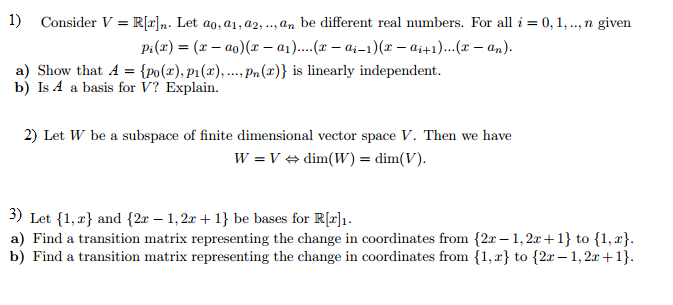
1.a. We must show the only linear combination of elements of A giving the 0 polynomial is the trivial combination. So, let c_0 p_0 + ... + c_n p_n = 0 for real numbers c_i. Plug in x=a_i. For each p_j with j != i, a_i is a root, so p_j(a_i) = 0. Thus c_i p_i(a_i) = 0. But p_i(a_i) is non-zero, so c_i = 0.
b. Yes. V is a vector space of dimension n+1 (standard basis: monomials 1=x^0, x^1, x^2, ..., x^n), and a linearly independent set of size equal to the dimension must be a basis.
2. If W=V, certainly the dimensions agree. On the other hand, if the dimensions agree, a basis for W, which exists, is necessarily a basis for V, so they are both given by the same linear combinations, hence W=V.
3.a. You want the matrix to take in coordinates of vectors in the first basis and spit out coordinates of vectors in the second basis. In particular, (1, 0) in the first basis means 2x-1, which is (-1, 2) in the second basis. Also, (0, 1) in the first basis means 2x+1 which is (1, 2) in the second basis. It follows that the matrix is
(-1 1)
(2 2)
[In general, the first column corresponds to the first standard coordinate vector's image, and likewise with the other columns.]
b. Nearly identical. (1, 0) means 1 = [(2x+1)-(2x-1)]/2 corresponding to (-1/2, 1/2). Similarly (0, 1) means x = ((2x-1)+(2x+1))/4 corresponding to (1/4, 1/4), so the matrix is
(-1/2 1/4)
(1/2 1/4)
(The finer points of the reasoning for 1b and 2 depending on exactly what definitions and propositions you're using. There are several logically equivalent approaches.)
The time you enjoy wasting is not wasted time.
Bertrand Russell
<- Remember to rate posts you find helpful.
 Posting Permissions
- You may not post new threads
- You may not post replies
- You may not post attachments
- You may not edit your posts
-
Forum Rules
|
Click Here to Expand Forum to Full Width
|



 Reply With Quote
