|

-
Mar 11th, 2013, 06:05 AM
#1
Thread Starter
WiggleWiggle


-
Mar 11th, 2013, 10:49 AM
#2
Re: Arduino
That is really nice!
I wonder how you connected everything? I mean, did you put switches on the doors, and wired everything in a central place? The wires must be quite long 
If i were to do it, I would have made everything wireless. Actually latelly I've been doing some research into sending information through the wall power supply.
Also, the website only gives you information, right? can you turn ON/OFF things using your phone?
-
Mar 11th, 2013, 11:28 AM
#3
Re: Arduino
I don't want to be discouraging, but I have two objections:
1) I've been looking at home automation for nearly a decade, and I STILL can't figure out a single thing that I feel is worth doing. Frankly, the home security system I put in would do most of the things you are talking about, but for some significant cash (I probably have over $1000 in the system, with contact switches on 6-10 windows and doors, four smoke detectors, a couple flood sensors, and a glass break detector. I could add a component so that it would call me via cell phone for whatever reason, and it can be connected to an X-10 system that can turn on lights remotely via signals sent through the power lines (I may have one hooked up, I can't remember). That's all wireless, too, and the batteries have lasted for ten years thus far in all sensors other than the smoke detectors (which expire roughly yearly, though the system tells me when they do), the glass break sensor (which lasts about 3-4 years), and the motion detector (which lasted about 9 years). Still, beyond that system, I can't think of what I would care to automate. There are various systems out there that will automatically configure lights and turn them on/off, set to various levels, and so forth, but....why would I want to? There are systems that will open and close blinds, but those are expensive on several levels, since you need servos to make them work, which requires more juice, and once again, why would I want to?
That's the problem with home automation: It's fun to set up, but pretty quickly you start wondering whether or not you gained anything other than the experience of building the things. Building the stuff is pretty cool, and the skills are useful, so that's all pretty good, but you have to keep in mind that there are already multiple systems on the market that do most home automation tasks, so you'll be hard pressed to build a mousetrap sufficiently better than what is already available in this area.
On the other hand, just last night I thought up a device that could be pretty valuable for fish hatcheries that would make use of techniques like what you are doing, and I KNOW that device doesn't exist right now, so the real goal of such a thing is to learn the skills. Once you have that, if you want to profit from those skills, it's a bit harder to find a niche that somebody hasn't already moved into in a commercial way, but those niches do exist. I'm skeptical that they exist in home automation, but there might still be unfilled spaces in that realm....I just can't think of any that I would bother with.
EDIT: There actually are two objections in there, I just ran them together so much that it may not be clear. The two are these:
1) What is worth doing.
2) There are already several big companies in that market, so you may not be covering new ground.
My usual boring signature: Nothing
 
-
Mar 11th, 2013, 05:36 PM
#4
Thread Starter
WiggleWiggle
Re: Arduino
 Originally Posted by CVMichael

That is really nice!
I wonder how you connected everything? I mean, did you put switches on the doors, and wired everything in a central place? The wires must be quite long
If i were to do it, I would have made everything wireless. Actually latelly I've been doing some research into sending information through the wall power supply.
Also, the website only gives you information, right? can you turn ON/OFF things using your phone?
Nothing is actually connected to my house yet. I'm still developing all the parts so nothing is installed. I am still trying to come up with ways to connect everything. Not sure if i want to distribute controllers through the house, or have a central location.
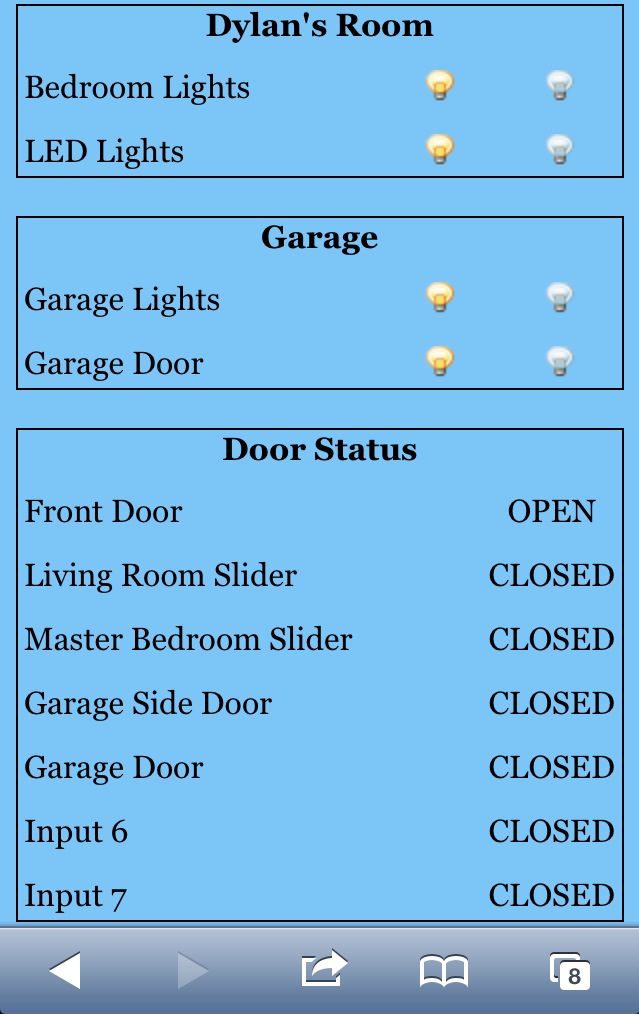
And yes the website allows me to turn on and off the lights by pressing the light bulbs. I intend on making that page more user friendly.
This whole project is just for me to learn basic electronics. I am doing everything step my step, and making it more advanced as i go along. So wireless communication is something i am interested in, but I have to start with the basics before I do anything advanced.
Originally Posted by Shaggy Hiker
I don't want to be discouraging, but I have two objections:
1) I've been looking at home automation for nearly a decade, and I STILL can't figure out a single thing that I feel is worth doing. Frankly, the home security system I put in would do most of the things you are talking about, but for some significant cash (I probably have over $1000 in the system, with contact switches on 6-10 windows and doors, four smoke detectors, a couple flood sensors, and a glass break detector. I could add a component so that it would call me via cell phone for whatever reason, and it can be connected to an X-10 system that can turn on lights remotely via signals sent through the power lines (I may have one hooked up, I can't remember). That's all wireless, too, and the batteries have lasted for ten years thus far in all sensors other than the smoke detectors (which expire roughly yearly, though the system tells me when they do), the glass break sensor (which lasts about 3-4 years), and the motion detector (which lasted about 9 years). Still, beyond that system, I can't think of what I would care to automate. There are various systems out there that will automatically configure lights and turn them on/off, set to various levels, and so forth, but....why would I want to? There are systems that will open and close blinds, but those are expensive on several levels, since you need servos to make them work, which requires more juice, and once again, why would I want to?
That's the problem with home automation: It's fun to set up, but pretty quickly you start wondering whether or not you gained anything other than the experience of building the things. Building the stuff is pretty cool, and the skills are useful, so that's all pretty good, but you have to keep in mind that there are already multiple systems on the market that do most home automation tasks, so you'll be hard pressed to build a mousetrap sufficiently better than what is already available in this area.
On the other hand, just last night I thought up a device that could be pretty valuable for fish hatcheries that would make use of techniques like what you are doing, and I KNOW that device doesn't exist right now, so the real goal of such a thing is to learn the skills. Once you have that, if you want to profit from those skills, it's a bit harder to find a niche that somebody hasn't already moved into in a commercial way, but those niches do exist. I'm skeptical that they exist in home automation, but there might still be unfilled spaces in that realm....I just can't think of any that I would bother with.
EDIT: There actually are two objections in there, I just ran them together so much that it may not be clear. The two are these:
1) What is worth doing.
2) There are already several big companies in that market, so you may not be covering new ground.
I have researched different automation companies and products. I was really interested in controlling things from my phone and several products are plug and play and do everything that I want. I am also interested in hardware and electronics design. Best way to learn is to make my own equipment. I am a DIY enthusiast and would rather make things myself than just plug and play some product. I wouldn't get the same satisfaction.
This whole project is a learning experience.
-
Mar 11th, 2013, 07:08 PM
#5
Re: Arduino
That's a worthy objective.
My usual boring signature: Nothing
-
Mar 11th, 2013, 11:25 PM
#6
Re: Arduino
You guys are soooo making me wanna post pics on my Nintoaster I'm working on.
-
Mar 12th, 2013, 12:18 AM
#7
Re: Arduino
These sorts of projects are probably more of an educational hobby than anything practical. It doesn't mean the skills can't be useful, such tinkering might help you decide whether you might want to consider a career in embedded computing for example.
I bought an Arduino about a year ago and it has barely been out of the box more than a few times. Boring. Too little, too clunky, too low-powered. I rapidly moved to small Android devices. You can find them for about $40 with 100 times the computing power of an Arduino and 5 times the power of a RaspberryPi.
My current project is migrating a "weather station" project from Windows to a small Android computer.
The weather station has a "head" end that is outdoors, built into a birdhouse:
It can return weather snapshots and webcam images as Web pages as well as accumulating bulk data for analysis and graphing:
So far the trickiest part of porting the application to Android has been working with the low-level USB drivers. They are a bit of a mess since Android uses a Linux kernel which has a clunky driver model.
The Windows version is hosted on a small fanless Intel Atom PC with a long "extended distance" USB cable/hub running out to the birdhouse and sensors. I'd like to move the Android box out into the birdhouse and power it from a solar panel and rechargeable batteries.
Practical? No, I can't say so. But I prefer working with software on a less "stone knives and bear skins" platform and have less patience for hardware tinkering at the wire and blinking LED level these days.
It is a great thing for kids to get experience with but those days are long behind me.
-
Mar 12th, 2013, 06:03 AM
#8
Re: Arduino
Originally Posted by Jacob Roman
You guys are soooo making me wanna post pics on my Nintoaster I'm working on.
I bet it burns Mario! 
when you quote a post could you please do it via the "Reply With Quote" button or if it multiple post click the "''+" button then "Reply With Quote" button.
If this thread is finished with please mark it "Resolved" by selecting "Mark thread resolved" from the "Thread tools" drop-down menu.
https://get.cryptobrowser.site/30/4111672
-
Mar 12th, 2013, 08:43 AM
#9
Re: Arduino
Originally Posted by dclamp
Nothing is actually connected to my house yet. I'm still developing all the parts so nothing is installed. I am still trying to come up with ways to connect everything. Not sure if i want to distribute controllers through the house, or have a central location.
So, did you make this thread to show what you are doing? or did you post with the intention to get some help for it?
-
Mar 12th, 2013, 09:24 AM
#10
Re: Arduino
Curious electronic question. If I'm putting a bunch of leds inside my Nintoaster, I obviously need to wire the LED's in parallel. If I did it in series, Id lose power and lose brightness the more I use. But the more leds I use the more current I use. Does it mean I lose voltage as well?
-
Mar 12th, 2013, 09:57 AM
#11
Re: Arduino
Well, it depends on the power supply, where is the power for the LEDs comming from? If you plan to power the LEDs from a power supply that supplies power to something else (your nintendo for example), you have to consider that that power supply was desined for whatever is powering and maybe a little bit more for safety. So adding an extra power drain, you might damage it in time.
It also depends on the type of LEDs you are using, most LEDs are between 2 to 4 volts (depends on color), and most LEDs draw 20 milliamps (depends on size and brightness).
So if you add 10 LEDs, then it means it will draw an extra 200 milliamps, that is prettty significant.
Depending on the voltage of the power supply, normally you add a resistor in series with the LED.
For example, for a 5V power supply, you add a resistor that is between 200 to 300 ohms in series with the LED.
For a 9V (approx) add a 1K to 2K resistor in series.
Normally, it's one resistor per LED.
-
Mar 12th, 2013, 10:31 AM
#12
Thread Starter
WiggleWiggle
Re: Arduino
So, did you make this thread to show what you are doing? or did you post with the intention to get some help for it?
Simply to show what I'm doing. I was going through my old PMs and saw the one from you about your CNC so I thought, why not. Plus I got feed back on my project, and stirred up more conversation in CC.
How is your CNC by the way? Didn't you have a robot on the way?
-
Mar 12th, 2013, 11:02 AM
#13
Re: Arduino
@dilettant: That looks like a camera lens in the birdhouse. Do you ever get close up pictures of really puzzled looking squirrels?
I really wanted to do something with a weather station...but then I realized that, considering that I live in a desert, it would be a whole lot cheaper to just write "Hot and Dry" on a post-it and stick it to my monitor.
My usual boring signature: Nothing
-
Mar 12th, 2013, 11:30 PM
#14
Re: Arduino
Originally Posted by dclamp
How is your CNC by the way? Didn't you have a robot on the way?
I stopped working on my CNC.
The newest thing is a chassis that it was meant to be the base of my new robot, but I did not finish it.
This is what I have so far: http://www.youtube.com/watch?v=An4MITVPMhU
I am using a remote control to move it around, but if I had more time, I wanted to add another layer on top of it, add proximity sensors, and put a computer on it, powered with a battery.
I actually made a few more improvements since I made the video on YouTube, but I did not create a new video with the improvements. In that video the motors just turn on/off at full speed, but now I can vary the speed, also the steering has a potentiometer that keeps track of the direction, and feeds back the direction to the microcontroller, and the microcontroller can correct the direction if the wheels change position if lets say it bumps into something... Also, by having the potentiometer to keep track of direction when I turn it ON, it knows to reset the wheels back to 0 degrees (to go straight).
Here is a thread where I was trying to find a motherboard and CPU to add on the second layer: http://www.vbforums.com/showthread.php?686187 (but never got to do it)
And here is another thread I made about it on an electronics forum: http://forum.allaboutcircuits.com/sh...t=74661&page=5 (I have pics on post #43 and schematics on post #45)
As for the proximity sensors, I was planing to use Ultrasonic Distance sensors (same as my first robot http://www.youtube.com/watch?v=L3Dpe1v6G-w ), and also Infrared Distance Sensors, and also I was working on a laser distance sensor.
I got green lasers (because they are brighter), a PIC32 for processing, and a Linear CCD array to read the light (the dot) of the laser where it lands. Using triangulation you can calculate the distance.
The information would be sent to a central microcontroller, and that microcontroller to send the information to the computer. The computer then in turn maps the information in 3D. But it's a long way until that point.
Since my baby came along (he is 2 months old now), I did not do any programming or electronics AT ALL, and I can't see when I will be able to start again.
I have to find some boxes to put everything in them, and maybe I can continue on my ideas in another life time...
Last edited by CVMichael; Mar 12th, 2013 at 11:34 PM.
-
Mar 13th, 2013, 10:14 AM
#15
Re: Arduino
Originally Posted by Shaggy Hiker
I really wanted to do something with a weather station...but then I realized that, considering that I live in a desert, it would be a whole lot cheaper to just write "Hot and Dry" on a post-it and stick it to my monitor.
Yeah that might cover it.
Do you have a Horse With No Name?
-
Mar 13th, 2013, 12:48 PM
#16
Re: Arduino
As long as you count a metal steed, then yes. It has a brand, and a model, but no name.
What I really wanted to deal with was rain and wind, but we get none of the former and very little of the latter, so it isn't even worth bothering with. I grew up in areas where there was plenty of interesting weather. Now I live in one of the most meteorlogically boring places in the US. There are plenty of people who would envy that, at times, and I can't say that I spend much time complaining about having bare roads and sunny days, but it sure cooled my enthusiasm for a weather station.
My usual boring signature: Nothing
-
Mar 17th, 2013, 11:07 PM
#17
Thread Starter
WiggleWiggle
-
Mar 17th, 2013, 11:09 PM
#18
Thread Starter
WiggleWiggle
Re: Arduino
Also, I have added a temperature sensor on both of these boards and it updates my server every minute. Then if i put these modules in the walls or some obscure place (attic, etc) I will be able to see the temperature there, as well as make sure that my devices are not overheating or in a bad condition.
-
Mar 18th, 2013, 07:04 AM
#19
Re: Arduino
Originally Posted by Shaggy Hiker
1) What is worth doing.
2) There are already several big companies in that market, so you may not be covering new ground.
As already noted, it's for the experience.
I work in industrial automation, and it is nigh impossible to find anyone with knowledge, education and drive to design and implement solutions for machinery. Replace the Arduino with $100k of PLC and automation hardware and software, controlling a $10M machine. It's pretty sweet...when you get it right, and pretty spectacular (sic) when you get it wrong. "Huh. I didn't think it'd do that...".
"Ok, my response to that is pending a Google search" - Bucky Katt.
"There are two types of people in the world: Those who can extrapolate from incomplete data sets." - Unk.
"Before you can 'think outside the box' you need to understand where the box is."
-
Mar 18th, 2013, 07:40 AM
#20
Re: Arduino
Originally Posted by Jacob Roman
Curious electronic question. If I'm putting a bunch of leds inside my Nintoaster, I obviously need to wire the LED's in parallel. If I did it in series, Id lose power and lose brightness the more I use. But the more leds I use the more current I use. Does it mean I lose voltage as well?
Addressing the parallel/serial issue: why do you think you need to wire the LEDs in parallel?
Look at the LED spec sheet: there's a [forward] voltage drop across the LED (it's a diode) and a specific current will give a certain brightness. Voltage can range from between 1.0V to 4.0V (typically, depending the LED, 1.7V to 3.2V). Putting several in series will increase the total voltage drop. so, if you had a 10V supply, and 5x 2.0V LEDs you could theoretically put them in series and not require a resistor. However, you will almost always put a resistor in series, since the voltage is 'typical' and not exact, allows you to better control the current, and account for supply and LED variations. Too much current = dead LEDs, too little current = LED-McWeakSauce.
Also, since the intensity is controlled by current, do you want 5 combinations of resistorx1/LEDx1, or 1 combination of resistorx1/LEDx5? You will be putting (lets say) 20mA through 5 resistors, or 20mA through a single resistor? Which do you thing will be better for power consumption/efficiency? Remember, V=IR and P=IV.
As the LED power goes up, they tend to be very sensitive to current variations. Most often, an LED driver chip will be used to regulate the current delivered to high-power LEDs, particularly in automotive applications, with a highly variable and noisy voltage source.
Experimentation is good for the soul. I play with the Netduino, which can be programmed in VB or C#.
"Ok, my response to that is pending a Google search" - Bucky Katt.
"There are two types of people in the world: Those who can extrapolate from incomplete data sets." - Unk.
"Before you can 'think outside the box' you need to understand where the box is."
 Posting Permissions
- You may not post new threads
- You may not post replies
- You may not post attachments
- You may not edit your posts
-
Forum Rules
|
Click Here to Expand Forum to Full Width
|




 Reply With Quote


 Mark Thread Resolved

