|

-
May 17th, 2008, 08:35 AM
#1
Thread Starter
Frenzied Member

 [RESOLVED] Simple Optimization [RESOLVED] Simple Optimization
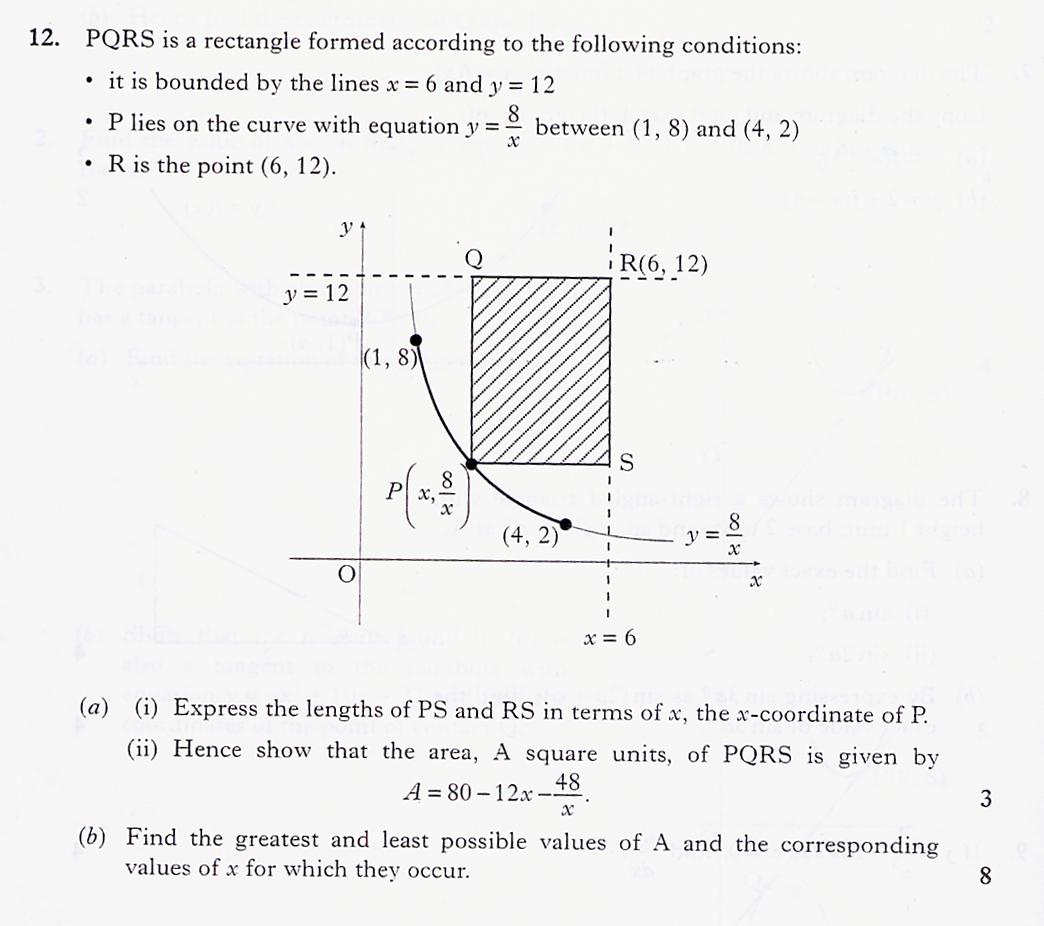
I am doing past papers to revise for my Higher exam on Tuesday and I came across a question that has completely stumped me. It is 12)b) on the attatched image. I have found the greatest possible value. It is 32 units2 and occurs at x = 2. I don't know how to get the minimum value though. According to the answers it is at x = 1 and x = 4 and the area is 20 units2.
Thanks for your help!
-
May 17th, 2008, 09:16 AM
#2
Re: Simple Optimization
Think about how you proved that the area was a maximum at x=2. You considered the rate of change of A with x and found the maximum by finding a point where the gradient was zero. You showed it was a maximum using the second derivative. If there was a minimum point, what would that suggest? How many solutions would you have found?
Hence you needed to check both ends to find out which of them results in the smallest area A.
-
May 17th, 2008, 09:26 AM
#3
Thread Starter
Frenzied Member
Re: Simple Optimization
Well I got x = 2 and x = -2? But -2 is incorrect? Is it something to do with the equation y = 8/x?
This has really confused me...
Edit: Here is my working
Code:
A(t) = 80-12x-(48/x)
A'(t) = -12+(48/x^2) = (48/x^2) - 12
A'(t) = 0
(48/x^2) - 12 = 0
48/x^2 = 12
48 = 12x^2
x^2 = 4
x = 2, -2
Last edited by 03myersd; May 17th, 2008 at 09:29 AM.
-
May 17th, 2008, 10:12 AM
#4
Re: Simple Optimization
Your working is correct.
Take a look at the question again and how everything is defined.
The curve on which P can move is defined by y = 8/x AND ...
-2 is technically correct, but not in this question. x = -2 is not a legal point for P!
-
May 17th, 2008, 10:19 AM
#5
Thread Starter
Frenzied Member
Re: Simple Optimization
I tried making them equal to each other but i got a completely different answer.... So I'm still lost....
-
May 17th, 2008, 10:31 AM
#6
Re: Simple Optimization
Ok a clear hint:
What are exactly all points where P can occur?
There are not infinite points for P to exist, therefore, there must be two end points. Did you check the area at the endpoints?
In other words:
P can exist only on the curve y = 8/x between the points (1,8) and (4,2).
Because P is bounded, if you think about it for a second, the area A MUST have at least one minimum and at least one maximum.
Where do you expect the minimum(s) to occur?
Yet another way:
Can you think of any position for P that would make the area A = 0 ?
Last edited by NickThissen; May 17th, 2008 at 10:36 AM.
-
May 18th, 2008, 02:56 PM
#7
Thread Starter
Frenzied Member
Re: Simple Optimization
So the minimums are at 1 and 4 because those are the boundaries of the curve?
-
May 18th, 2008, 03:38 PM
#8
Re: Simple Optimization
In this case, yes.
In mathematical terms it can be understood if you know more about how to find maximum and minimum values.
Before calculus, students usually learn that a maximum and minimum value (extreme values) can only occur at the points where the derivative is zero (zero slope).
There are 2 other cases however!
In general, extreme values of a function f(x) can (not must) occur at either of these points:
- critical points of f (points where f'(x) = 0),
- singular points of f (points where f'(x) does not exist/is not defined),
- endpoints of the domain of f
In this case, the endpoints are of interest.
An easier explanation for this example is simply that if the x-coord of point P goes from 1 to 4 (which are the endpoints), the area A starts at a minimum at x = 1, then increases to a maximum at x = 2, then decreases again to the same minimum at x = 4.
Note that the endpoints (x = 1 and x = 4) do not HAVE to give minimal values for A! It is perfectly possible for A to decrease further after x = 1 (although not in this example).
But it is always a good idea to check the endpoints if the function you are given is on a finite domain, especially if you can't find any minimum algebraically without checking the endpoints!
So the final answer here is that x = 1 and x = 4 are minimum values simply because the point P cannot exist before x = 1 and after x = 4. If P could exist beyond those points (for example at x = 6) then x = 1 and x = 4 would no longer be a minimum. (The area at x = 6 for example is 0).
Do you understand? If you don't understand the singular / endpoints type of thing don't worry, I don't think you have to know these things in the way I have described them... You just need to 'see' them.
It's all logical if you think about it... If a curve is defined only between two values for x, then it obviously must have at least one minimum value and at least one maximum value (except if the line is a straight line, y = constant, then you could argue that it has none...)
-
May 18th, 2008, 04:26 PM
#9
Thread Starter
Frenzied Member
Re: Simple Optimization
As far as I know, we don't need to know them, but it can't hurt to.
If we look at a graph for area would this be what we get:
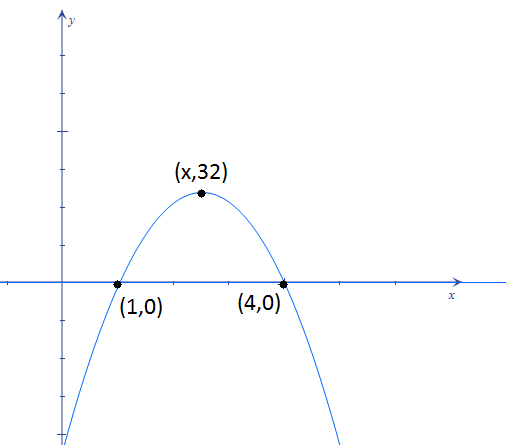
And the boundaries are 1 and 4 simply because thats the range that P can be on, going by the diagram given in the question?
-
May 19th, 2008, 09:45 AM
#10
Re: Simple Optimization
To be honest I would have to say that the graph for the area is wrong.
Firstly (but not very important for the matter at hand) the area is not 0 for x = 1 and x = 4.
But more importantly, because the boundaries (x=1 and x=4) are clearly given. You have drawn the graph before x = 1 and after x = 4, and the area there is not defined (does not exist) because the point P cannot exist there.
Usually this wouldn't be a huge problem, but if you look at the graph only you would definately not conlcude that x = 1 and x = 4 would be a minimum value.
If you erase the graph for x < 1 and x > 4 it would be right, and the minimum values there would be more obvious.
So yes, the boundaries are x = 1 and x = 4 because that is how the function is defined.
Although the question only states it indirectly, the function A(x) can be written more formally as:
A(x) = 80 - 12x - 48/x , 1 <= x <= 4.
(In the question it is stated indirectly because the area is bounded by some point P lying on some curve, defined by y = 8/x, 1 <= x <= 4.)
But I think we are going way to 'technical' on this problem...
You just need to think about it logically, and you can also see it clearly from the graph you have drawn:
For x < 1 and x > 4, the area would decrease even further and so x = 1 and x = 4 would generally NOT be a minimum.
But, because the point P is limited to lie between x = 1 and x = 4, both values x = 1 and x = 4 give a minimum value for the area (since P cannot go any further).
-
May 19th, 2008, 01:22 PM
#11
Thread Starter
Frenzied Member
Re: Simple Optimization
I went into school today and asked my maths teacher about it. She spent about half an hour explaining before I understood it. And i'm not even going to try and put it back into words. 
Sorry for wasting your time. I appreciate you trying to help me though. Thanks!
Edit: I tried to give you rep but it looks like I need to spread some around before coming back to you again. Sorry.
-
May 19th, 2008, 02:14 PM
#12
Re: Simple Optimization
Don't worry about the rep lol, I don't care, I do it to help people, not to get rep 
So you do understand it now? It's not that hard, is it?
-
May 19th, 2008, 02:17 PM
#13
Thread Starter
Frenzied Member
Re: [RESOLVED] Simple Optimization
Well not really no. It's just reading the question. If I could use my calculator on this question I could have graphed it and been done very quickly. Its because I didn't that I wasn't sure. But I should be ok. If not im a bit late now. It's first thing in the morning.....
-
May 19th, 2008, 02:47 PM
#14
Re: [RESOLVED] Simple Optimization
Ok one last try to explain it,
If the point P starts at x = 1 and then 'walks' gradually to x = 2, while the area A is increasing, and you know x = 2 is a maximum. What can you say about the point at x = 1 then? Obviously it must be a (local) minimum.
The same goes for x = 4. Because x = 2 is a minimum, you know A must decrease after x = 2. Since P cannot go beyond x = 4, x = 4 must be a (local) minimum. Further investigation (entering x = 4 in the formula for A to find the area) shows that the area on x = 1 and x = 4 is equal, so the points are both absolute minimas.
(If you don't know the differrence between local and absolute minimas, don't worry about it! Just ignore this then.)
Here's two graphs:
First, the graph of the function:
y = 80 - 12x - 48/x

Then, the graph of the function:
y = 80 - 12x - 48/x , 1 < x < 4 (or, x between 1 and 4)

(Disregard the dots at x = 1 and x = 4 on the x-axis, I don't know how to get rid of them...)
The second graph is the graph of the function in your question.
If you look at the clear difference between them, is it now obvious why x = 1 and x = 4 are minimum values (in the second graph) ?
Now, I don't know if you can use a graphic calculator capable of drawing graphs, but even if you can't, this is just for demonstrational purposes. You don't need to graph to solve the question; you can see it logically aswell.
-
May 19th, 2008, 02:51 PM
#15
Thread Starter
Frenzied Member
Re: [RESOLVED] Simple Optimization
Nope that makes absolute sense. Thanks. More or less exactly how my teacher explained it. Yeah I use my calculator the whole time.
By the way, what program do you use for drawing graphs? I currently use Microsoft Math. I use it for lots of things involvings maths but i'm wondering what the alternatives are?
-
May 19th, 2008, 02:55 PM
#16
Re: [RESOLVED] Simple Optimization
I'm using Maple 11.
I also know of Mathematica, Matlab and MathCad which are probably more or less the same as Maple.
They're not just for drawing graphs, you can do whatever you want with them... Calculate (anti)derivatives, solve ridiculously complex equations, etc...
-
May 19th, 2008, 03:54 PM
#17
Re: [RESOLVED] Simple Optimization
A non-mathematical way to look at it is that you know there is only one point on that line where the gradient is zero; that's where you found the maximum. And since it is a maximum, and you know the gradient never flattens out, it must be downhill all the way on both sides. Which must mean that the minima are at the endpoints. One could be lower than the other, so you have to check both.
-
May 21st, 2008, 04:04 AM
#18
Thread Starter
Frenzied Member
Re: [RESOLVED] Simple Optimization
Thanks for that Nick. Microsoft Math does all that too. Probably isn't as advanced, but is still nice and simple to use. It just came with the new version of encarta and so I started using it. Ill have a look at the others though. Thansks.
Zaza: Thats more or less the way my teacher explained it. Thanks!
-
May 22nd, 2008, 05:22 AM
#19
Re: [RESOLVED] Simple Optimization
Nifty way of thinking about that Zaza
Though, I'd be impressed by whomever would come up with it straight-off in an exam situation, when they haven't thought about a function like this in this way before.
The time you enjoy wasting is not wasted time.
Bertrand Russell
<- Remember to rate posts you find helpful.
-
May 22nd, 2008, 11:30 AM
#20
Thread Starter
Frenzied Member
Re: [RESOLVED] Simple Optimization
Just to say, nothing even remotely like it came up in either of the papers. It was all pretty easy except the final two questions on paper 2, which took a little bit of thinking and a lot of time to do.
-
May 22nd, 2008, 03:59 PM
#21
Re: [RESOLVED] Simple Optimization
This is a really good example of why exams are often hard; they require you to think more about a subject you have studied, instead of simply plugging in values in formulas which you have done hundreds of times before... In this example the question requires you to 'invent' a new (for you) kind of maths which you may have never seen before. The smart students thinks about it logically and finds the answer, the normal student forgets about it or doesn't know how to find the additional required answers..
This question is a test to see if you can come up with the idea to check the endpoints. I guess most people won't even think of it (and to be honest neither would I directly!)
However, the question does help you out asking you to find both the greatest and least possible values of A. If you can only find one greatest value for A using differentiation, most people will stop and think, "wait, I was supposed to find a minimum too... where is it?".
If the question asked "Find the extreme value(s) of A" for example, the step to check the endpoints is much more easily forgotten.
 Posting Permissions
- You may not post new threads
- You may not post replies
- You may not post attachments
- You may not edit your posts
-
Forum Rules
|
Click Here to Expand Forum to Full Width
|



 Reply With Quote


