|

-
Apr 5th, 2008, 07:27 AM
#1
Thread Starter
Frenzied Member

 [RESOLVED] Integration [RESOLVED] Integration
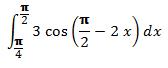
I've been on holiday from school for a couple of weeks now and im doing my homework before I go back. However one of the problems is giving me a really hard time. I just cant figure out how to do it. I know that the answer is 1.5 but I want to know the steps of it so I can do it if it comes up in my exam. Any help is greatly appreciated. Thanks!
-
Apr 5th, 2008, 09:25 AM
#2
Re: Integration
You can do this in two ways.
First of all, have you noticed that cos(Pi/2-x) = sin(x) ?
If you do then the integral becomes:
int( 3*sin(2x) dx) which looks alot easier!
Do you know the integral of a normal sin function?
int(sin(ax)dx) = (-1/a)*cos(ax) + c
Using this on (3*sin(2x)) you get:
int( 3*sin(2x)dx ) = (-3/2)cos(2x) + c
Evualating the integral on the interval Pi/4 to Pi/2 we get:
[ (-3/2)cos(2Pi/2) - (-3/2)cos(2Pi/4) ]
= (3/2)cos(Pi/2) - (3/2)cos(Pi)
= (3/2)*[cos(Pi/2) - cos(Pi)]
= (3/2)*[ 0 - (-1) ]
= 3/2 * (+1) = 3/2
(You can leave out the constanct c here since it will always cancel out of the equation)
However, the first substitution for cos(Pi/2-x) = sin(x) only works in special cases like this one.
The general solution however is not very different once you figure out that:
int( cos(a - bx)dx) = (-1/b)*sin(a-bx) + c
So returning to your problem:
int( 3 * cos(Pi/2 - 2x)dx ) = 3 * (-1/2) * sin(Pi/2 - 2x)
= (-3/2) sin(Pi/2 - 2x)
Entering the values gives you:
[ (-3/2) sin(Pi/2 - 2Pi/2) - (-3/2) sin(Pi/2 - 2Pi/4)
= (3/2)sin(Pi/2 - Pi/2) - (3/2)sin(Pi/2 - Pi)
= (3/2) [ sin(0) - sin( - Pi/2) ]
= (3/2) [ 0 - (-1)] = 3/2 * 1 = 3/2
Which ofcourse gives you the same answer.
However, you should really notice that sin(Pi/2 - x) = cos(x), it will make your life easier. Perhaps not necesarely with this problem but definately with more advanced problems!
EDIT
Also, when integrating, always differentiate your result to check yourself. It doens't take alot of time at all and you can easily spot a stupid mistake you might have made.
-
Apr 5th, 2008, 09:27 AM
#3
Thread Starter
Frenzied Member
Re: Integration
 Originally Posted by NickThissen
First of all, have you noticed that cos(Pi/2-x) = sin(x) ?
I managed to take it from there.... I feel a bit dim now! lol.
Thanks for your help!!
-
Apr 6th, 2008, 04:13 AM
#4
Re: [RESOLVED] Integration
You might want to review u substitution since it'll almost certainly show up on any Calc exam you'll take involving integrals, and this problem is perhaps best solved with it. Good luck 
The time you enjoy wasting is not wasted time.
Bertrand Russell
<- Remember to rate posts you find helpful.
-
Apr 6th, 2008, 04:26 AM
#5
Re: [RESOLVED] Integration
I don't know how it's done in Scotland but here in holland we never had to use any substitution method for our final exams. Every intergral was possible without substitution. I only learned the substitution method at university so it might be that he doesn't need to know it.
Also, why would this problem be best solved with it? If you rewrite the cos as a sin then it's just a standard integral?
-
Apr 6th, 2008, 05:50 AM
#6
Thread Starter
Frenzied Member
Re: [RESOLVED] Integration
Well we don't do that..... Lol. Perhaps that comes up at advanced higher....
-
Apr 8th, 2008, 04:24 AM
#7
Re: [RESOLVED] Integration
The first part of that page is really unnecessarily complicated... the actual substitution examples are the guts of it, and are really much simpler than everything else. As for why I thought it was best solved with substitution--I guess I was thinking that substitution works in the general case, and a more general method is preferable to one special [even lucky] case.
I guess they teach Calculus differently in Europe though. The idea of u substitution goes so well with beginning integral calculus that I just assumed that's how anyone would teach it, but, eh, I guess it's not.
Often reverse-engineering the integral can work as well. In this case you could have guessed that it was some form of sine and figured out the coefficients and arguments, pretty much as NickThissen suggested in his first post.
The time you enjoy wasting is not wasted time.
Bertrand Russell
<- Remember to rate posts you find helpful.
-
Apr 8th, 2008, 10:20 AM
#8
Re: [RESOLVED] Integration
But this integral is not a special, even lucky, case at all?
It is just easier to see the solution if you rewrite it as a sin, getting rid of the Pi/2. However, even if instead of Pi/2, you would have some random number like 5, the method is exactly the same.
Int( 3*cos(5-x)dx) = -3 * sin(5-x) + c
The 5 does not change the method required to solve the integral.
It would be a different case however if you had a function like 3*cos(5x - x² or whatever.. this cannot be solved with the same method and requires substitution or some more advanced methods. or whatever.. this cannot be solved with the same method and requires substitution or some more advanced methods.
The whole method described by me above indeed relies and reverse engineering the function. Or as my teacher used to say, you have to take a smart guess.
If you know how to do derivatives then you can also do easy integrals like this one.
You know the derivative of a sin is a cos, so you know the integral of a cos must be a sin. Then you can just guess some equation containing the sin that looks like your original equation, and try to differentiate that. That helps you find the coefficients you migth need to add.
 Posting Permissions
- You may not post new threads
- You may not post replies
- You may not post attachments
- You may not edit your posts
-
Forum Rules
|
Click Here to Expand Forum to Full Width
|



 Reply With Quote
